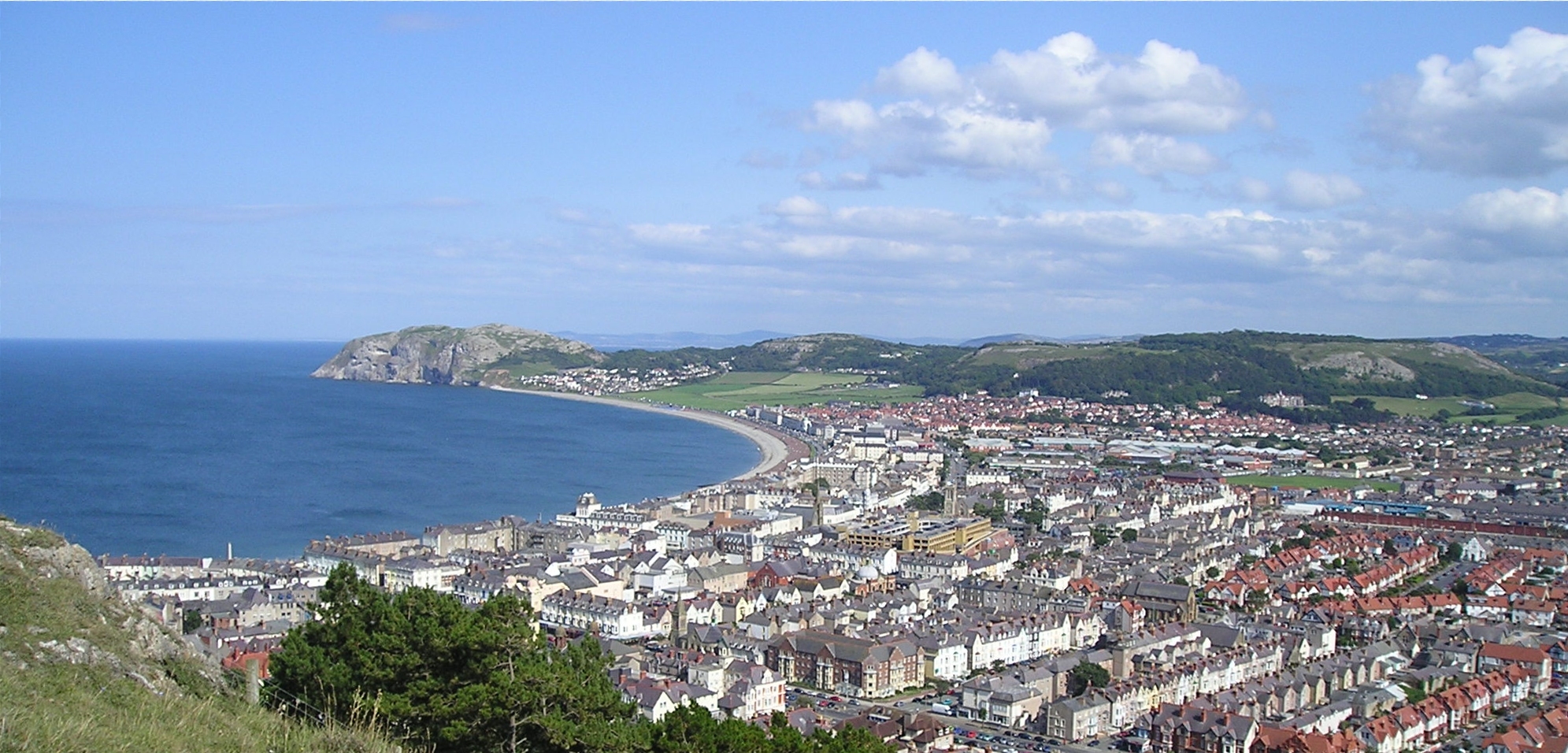

The queen of north Wales holiday resorts stretches itself around the wide, sandy sweep of Orme Bay, between the headlands of the Little Orme to the east and the Great Orme to the west. Between the two the town lies brilliantly in the sunshine which seems to make its home here for most of the year a vast curve of hotels and boarding houses - more than 2000 of them - theatres, cinemas, amusement centres, lying back from the 1 ½ mile long promenade and the great golden sands thronged with bathers and holidaymakers.
Llandudno really straddles the low, narrow peninsula made by the jutting Great Orme. Indeed, not content with one magnificent sea front, the has Conway Bay, or the west shore, to the south-west as a second. This latter is a veritable children's paradise, with sands that stretch far out at low tide. The main front, of course, is the Orme Bay. Along the length of the broad promenade lie, among other amenities, a bandstand, on the sands, with “Arcadia,” the large amusement centre, nearby. Farther west, the half-mile long pier runs seaward, with the great pavilion, seating 4000 beside it. In the pavilion concerts are held regularly, and the town has its own orchestra.
From the pier, which has facilities for bathing at certain times, there are steamer trips to Anglesey, the Isle of Man, and round the noble Great Orme. The sands of Orme Bay are very fine, and the bathing is safe. It is still to some extent done from the old-fashioned machines, which are popular. Apart from the wonderful facilities for bathing and boating, the town offers plenty of scope to golfers, with its two full courses, the Great Orme Course on the headland, and the North Wales Club on the West Shore. Both are first-rate courses. Facilities also exist for tennis, bowls, fresh- and salt-water fishing, and many other sports.
The Grand, Vaudeville and Winter Garden theatres provide shows and concerts, while the town is well supplied with cinemas and dance halls. Llandudno is a well-laid-out town, with a sense of spaciousness. Not only does it have the wide stretch of promenade, but the streets themselves are large and attractive.
Mostyn Street is the main centre, and there is also the great Gloddaeth Street and avenue which runs from the Orme Bay right through to the west shore. The Great Orme, of course, is one of the principal attractions of Llandudno, and here man has added to Nature to increase the scenic value and amenities. Here are the Haulfre Gardens, a lovely spot, where teas are served-nobly sited on the slopes of the headland; the Orme Tramway, a cable car which climbs right up to the Great Orme golf course; while the Marine Drive is a 'must' for all visitors. This road is a clever piece of engineering, cut out of the rock of the headland, running seemingly precariously above the sea, and at times tunnelled into and buttressed by the rock of the Orme. Half way round there is the Great Orme Lighthouse. The view all round the Marine Drive is one of changing splendour. Now the sea, now Anglesey comes into view, and finally the high, distant peaks of Snowdonia. Traffic on the Drive is one-way only, starting from near the Pier. The Great Orme has some interesting caves, the Llech cave being the bets. In this respect the Little Orme is not far behind.
Conway Bay, on the west shore, while not so suitable for sea-bathing, is compensated by having the Deganwy Swimming Pool. The view from the Bay across into Snowdonia is very good. Here, too, is a model yacht pond, and the North Wales Golf Course. One of the chief attractions here is the Happy Valley, on the slope of the Orme, a well-laid-out public garden with seats, lawns, a profusion of semi-tropical plants, and a very excellent rock garden. Happy Valley is a popular place with mothers and children.
The surrounding country makes excellent rambling. The Great Orme is large enough for many a pleasant excursion. One of its attractions is the lonely little St. Tudno's Church - Llandudno means “church of St. Tudno” - a fifteenth-century building incorporating some eleventh- and twelfth-century work in its walls. The original church was built here in the sixth century. Within easy reach, too, are Conway with its ancient Castle, and the rival resort of Colwyn Bay, while Deganwy, the other great castle of the district, is only a walk away to the south-west.

Conway Bay, on the west shore, while not so suitable for sea-bathing, is compensated by having the Deganwy Swimming Pool. The view from the Bay across into Snowdonia is very good. Here, too, is a model yacht pond, and the North Wales Golf Course. One of the chief attractions here is the Happy Valley, on the slope of the Orme, a well-laid-out public garden with seats, lawns, a profusion of semi-tropical plants, and a very excellent rock garden. Happy Valley is a popular place with mothers and children. The surrounding country makes excellent rambling. The Great Orme is large enough for many a pleasant excursion. One of its attractions is the lonely little St. Tudno's Church - Llandudno means “church of St. Tudno” - a fifteenth-century building incorporating some eleventh- and twelfth-century work in its walls. The original church was built here in the sixth century. Within easy reach, too, are Conway with its ancient Castle, and the rival resort of Colwyn Bay, while Deganwy, the other great castle of the district, is only a walk away to the south-west.

The Town is very vibrant and has many new shops including the new Parc Llandudno retail development and the Mostyn Champneys Retail Park. More info... Visit Llandudno Web Site or My llandudno.

Many great shows and entertainments take place at Venue Cymru.
Useful Links:
MyLlandudno - My Llandudno Tourist Information and Local Business Guide
Indian Restaurant Llandudno - Jaya Fine Indian Cuisine
Visiting Today
Llandudno is the best-preserved Victorian seaside resort in Britain and one of the finest examples of planned urban development of its era anywhere in the country. The town was laid out from scratch on the flat neck of land between the two headlands of the Great Orme and Little Orme in the 1850s and 1860s, following a plan by the surveyor Owen Williams. The formal grid of streets, the broad seafront promenade, the pier (the longest in Wales), and the uniform quality of the terraced hotel architecture give the town a coherence and grandeur that has survived remarkably intact. The Grand Hotel, the Imperial, and dozens of smaller establishments still line the promenade as they were built.
The Great Orme headland, rising 207m above the town, is the defining landscape feature of the area and contains more history and natural interest than almost any comparable area in Wales. The Great Orme Tramway — the only surviving funicular cable tramway in Britain operating on public roads — runs from the town centre to the summit, with a Victorian station at the top giving views that in good conditions extend from Snowdonia to the Lake District. The Cable Car gives a parallel ascent option. The Bronze Age copper mines on the Orme, mined from around 3500 years ago, are open for underground tours and are the largest known prehistoric mine in the world.
The Great Orme Country Park covers the headland and its limestone grassland supports a population of Kashmir goats (descendants of a Victorian gift from the Shah of Persia), rare wildflowers, and excellent birdwatching on the sea cliffs. The town also has a strong association with Lewis Carroll, who holidayed here as a child and is believed to have encountered the original Alice Liddell in the town. The Alice in Wonderland Centre on Trinity Square is a tourist attraction based on this connection.
Llandudno has excellent rail connections — the main station is on the North Wales Coast Line with direct services to Chester, Crewe, and London Euston, and the branch line to Llandudno Junction gives connections to the Conwy Valley line. The town has a full range of shops, restaurants, theatres, and accommodation. It is the main retail and cultural centre for the north-east Wales coast.